


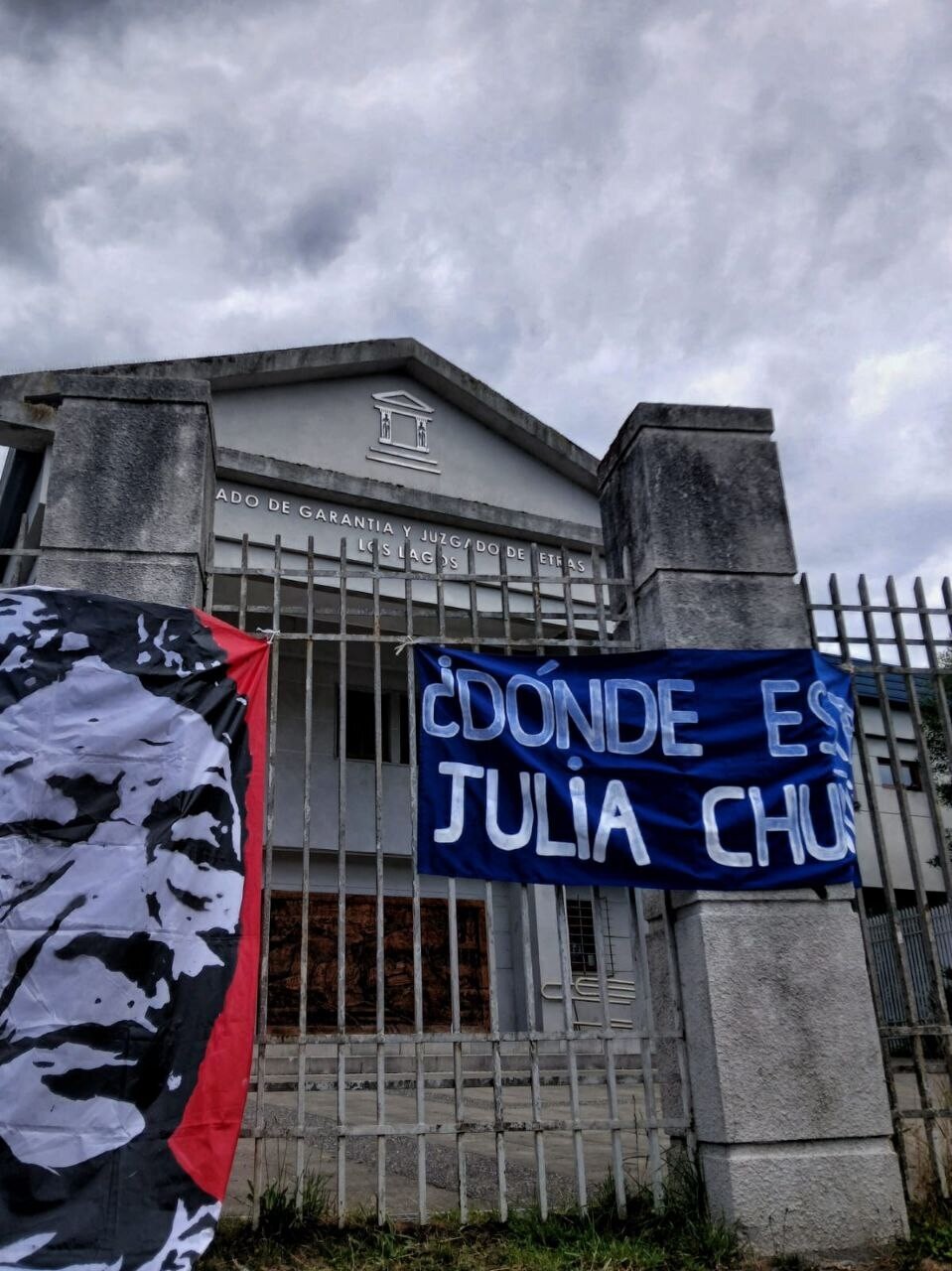
An unprecedented resolution was recently made public: Chilean justice has granted the prosecution's request to proceed with the demolition of the house where Julia Chuñil lived.
On Tuesday, January 27, a new judicial hearing was held for the case of Julia Chuñil's disappearance. Since her disappearance, not a single step has been taken in the investigation into forestry businessman Carlos Morstardt, whom Julia's family points to as the main suspect. His testimony, a fundamental piece for building the case, was given in isolation and without a defense lawyer present.
This operation of impunity not only seeks to exonerate the forestry businessman from Julia Chuñil's disappearance but also aims to absolve the State of its responsibility in searching for her. On both sides of the Andes, States and their institutions (regardless of the political sign in power) seek to build false accusations against Indigenous Communities to divert attention from the responsibility that the forestry industry has for the advance of fire over the territories.
The Julia Chuñil case demonstrates to what extent the collusion and coordination of Governments, state institutions, and forestry operators operate to reproduce a system that only brings destruction and death to the southern territories. The order to destroy Julia's house is another example of the political orientation with which they seek to shape a submissive memory, one that is functional to the impunity and business of the forestry companies.
Despite any arbitrary judicial order; despite the fire, criminalization, prison, evictions, and dispossession, our memory cannot be erased. Like the fern, it will sprout again from the ashes to continue defending life.
In contrast, a frame-up is being built against the family, with the objective of creating an operation of impunity. All of this has been accompanied from the very moment of the raids by an intense media campaign that has dedicated itself to sowing all kinds of speculation to create a scapegoat in Javier Troncoso Chuñil, Julia's son, whom the prosecution points to as the material perpetrator of the murder.
The request to destroy the house of the community leader located in Máfil is part of a long chain of harassment actions that pursue the objective of annihilating her memory. This was made explicit by prosecutor Tatiana Esquivel, who in her plea during one of the last hearings stated that the question of where the Mapuche grandmother is should no longer be directed at the State, but at the family itself.
In this instance, prosecutor Tatiana Esquivel, known for her explicit racism and constant harassment of Julia Chuñil's family, has taken a new step in her obsession with erasing the Mapuche grandmother's memory. On both sides of the Andes, fire advances, razing native forests, fauna, homes, and human lives. Media and judicial setups are the tool that the States of Chile and Argentina use to divert attention from the environmental collapse in which we are immersed and thus continue to guarantee dispossession.
The main testimony about the family's responsibility in Julia Chuñil's murder was provided by Julia's son-in-law, one of those detained in the raids. On this occasion, he has requested the demolition of the house where she lived. In a few days, it will be 15 months since the disappearance of the President of the Putreguel Community. From the very moment of her disappearance, the family has denounced all kinds of threats and different forms of intimidation, which include the murder of several animals belonging to Julia and an attempt to obtain a confession about responsibility for the crime from one of her daughters through illegal pressure.
Just a few days ago, the case took a surprising turn with the carrying out of raids on the homes of several relatives, detaining three of her children and Julia's son-in-law. The family's lawyer has denounced that the testimonies to build the accusation against the family contradict each other. They seek to divert responsibility from the businessman for Julia's disappearance.