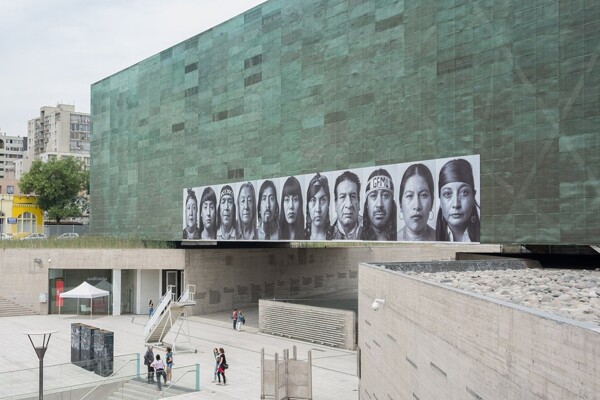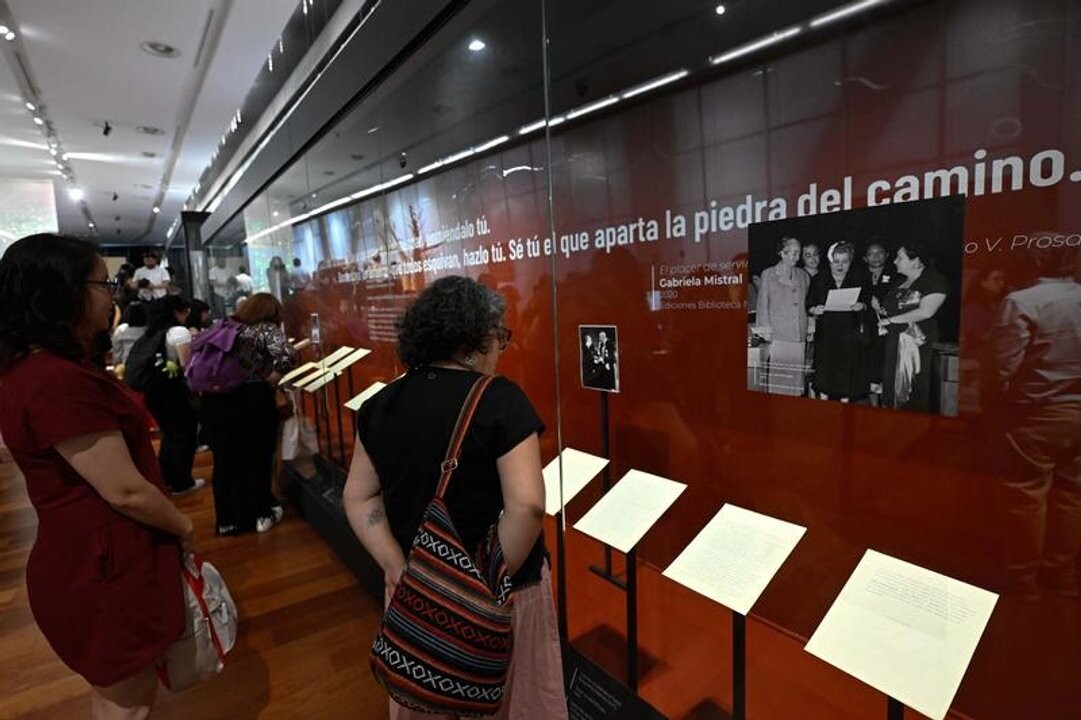
At the Cultural Platform of the Juan Gómez Millas campus of the University of Chile, in the east of Santiago, the exhibition “Gabriela Mistral: teacher of America, voice in the world” has begun, which invites reflection on the first Latin American woman to win the Nobel Prize in Literature. At the inauguration, held last Thursday, the Vice Rector of Extension and Communications (Vexcom) of the University of Chile, Pilar Barba, stated that this 2025 is a “Mistralian year” that, through different activities, has allowed for a connection “with the legacy of our Nobel laureate.” She celebrated that the exhibition is a collaborative work between Vexcom, the Andrés Bello Central Archive, the Tomás Lago Museum of American Popular Art (MAPA) and XR Labs, all departments of this institution, as learned by the Argentine News Agency (NA) through Xinhua. “Teams with different methodologies and languages that, to spread Mistral's legacy, came together to propose a common perspective.” In Buenos Aires, December 21 (NA) — A multidisciplinary exhibition invites to rethink the legacy of the Chilean Nobel Prize in Literature Gabriela Mistral (1889-1957), 80 years after this recognition, with art pieces, archival materials, and a video that reinterprets with artificial intelligence, from a photograph, the poet's last visit to the South American country. “We had two documentary sources: a photograph, which is the moment when Rector Juan Gómez Millas gives the diploma to the poetess, and on the other hand, a book that reconstructed the history of that event,” detailed a University of Chile academic. He highlighted that they reconstructed in the video everything from the honor hall of the time, which is different today, to each of the attendees. In the exhibition, visitors can also interactively review the first editions of the works Tala (1938), Lagar (1954), Desolación (1922), Ternura (1924), Lectura para Mujeres (1923) and Poema de Chile (1967). #AgencyNA Likewise, the Minister of Cultures, Arts and Heritage, Carolina Arredondo, celebrated that in Chile more than 250 activities were held within the framework of Mistral's Nobel, which not only served to remember a historical milestone. Among the works on display, the “Tree of Life” by Pablo García, Macarena González, Catalina Mateluna and Paola Santander stands out, a plot and warp in wicker that honors the poetess and “her thought, her sensitivity, her commitment to education and her inspiring vision in her land.” In this piece, visitors hung messages on the tips of the wicker tree, a natural fiber with an atavistic tradition in the Chilean rural world, from which baskets to fine ornaments are made; Mistral honored in her poetic work the trades and rural life. Also highlighted is the “Materioteca tintórea y pigmentaria” (Dyeing and Pigment Materioteca), a display case that brings together plant species, soils, and clays that evoke Mistral's imaginary. But the piece that captured the most attention from visitors was “Mistral XR,” an audiovisual work developed by the XR Labs laboratory, which recreated with artificial intelligence Gabriela Mistral's last visit to Chile, when she received an honorary doctorate from the University of Chile in 1954. The director of XR LABs, Víctor Fajnzylber, explained to Xinhua that this work “is part of one of our research lines on new theories of the image, in this case generative artificial intelligence.” “We created a closed installation, it is a black box, in such a way that we forget the environment, the external context.” He pointed out that Mistral's legacy not only belongs to history or books, “but is activated every time we defend culture, education as a right, and the diversity of perspectives, artistic creation as a space for reflection and encounter.” “A voice that reached the entire world without ever renouncing her Latin American roots, her commitment to public education, to social justice, and to the dignity of peoples,” the official added. “The diversity expressed here between heritage, art, research, technology, and contemporary creation is not a casual sum, it is the reflection of a complex public university (...) capable of thinking about Mistral from multiple dimensions,” she highlighted. “We also heard again a voice that continues to challenge us,” she clarified.