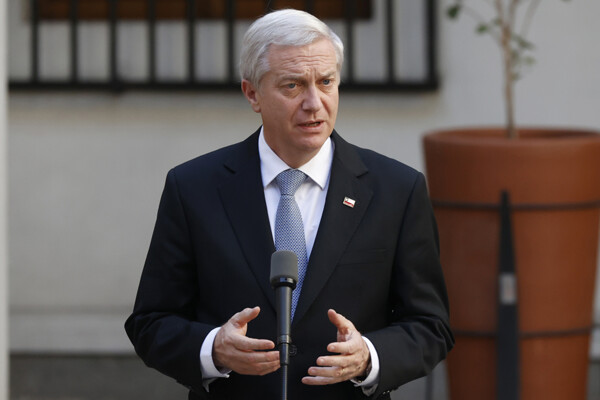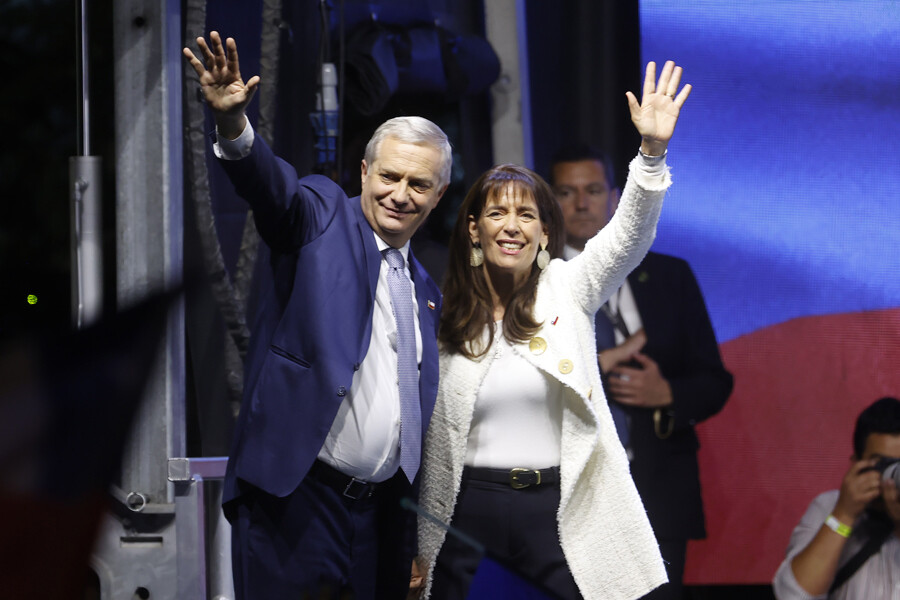
Santiago de Chile, Dec 14 (EFE). - Chile's president-elect, the far-right José Antonio Kast, attributed his overwhelming victory in this Sunday's elections to God and asked for "temperance and strength to be up to the task," while promising to "restore respect for the law" in the country.
The bloc of countries, under the umbrella of the American Donald Trump, that have monopolized their agendas with the management of public order and the migration crisis, gains a new ally this Sunday following the victory of far-right José Antonio Kast in Chile's presidential elections.
Kast's new Chile, which won the election with 58.1% of the vote against 41.8% for the leftist Jennette Jara, will form, alongside Javier Milei's Argentina, a far-right pole in the Southern Cone, in tune with other governments such as those of Salvadoran Nayib Bukele, Ecuador's Daniel Noboa, or Santiago Peña in Paraguay.
Milei was the first to congratulate Kast and stated that both governments will work together "so that America embraces the ideas of freedom" and "liberates" itself from "the oppressive yoke of 21st-century socialism".
"With the exception of Brazil, which is almost half of South America, the rest of the Spanish-speaking countries are betting on governments ranging from hyper-conservative to radical right," Gilberto Aranda, a professor at the University of Chile, told EFE.
For Carlos Malamud, main researcher for Latin America at the Elcano Royal Institute (Spain), "people vote thinking about immediate solutions to their problems."
As he explained to EFE, Argentines voted for Milei because they thought he would solve inflation and revive the economy; Chileans voted for Kast to improve security and manage migration.
"Alignment with the U.S."
The ultra-Catholic lawyer and former deputy, who will be the first president to have defended the then-dictator Augusto Pinochet (1973-1990) and campaigned for his continuation in the 1988 plebiscite, chaired the ultra-conservative Political Network for Values (2022-2024) and has participated in summits such as the Conservative Political Action Conference (CPAC) or the Vox convention in Madrid.
"There is a geopolitical alignment favorable to the U.S.," says Aranda.
"This is support for his security strategy," the text states, which arises at a time when Trump "is reaffirming the Monroe Doctrine" and wants to restore his regional dominance after years of disinterest.
The Latin American far right, he adds, will face the "dilemma" of deciding whether to accept the U.S. demand to deny China access, while countries such as Argentina and Chile, among others, maintain a significant part of their trade with the Asian giant.
"They will have to define if they prioritize pragmatism or if they align absolutely with the United States," Aranda posits.
"Punishment vote or rightward shift?"
Kast's victory, leader of the Republican Party, supported by other right-wing and far-right candidates who did not make it to the second round, is read as a punishment vote against the government of progressive Gabriel Boric, who has not managed to solve the priorities of the citizenry, such as reducing insecurity.
"We have a volatile electorate that alternately punishes depending on the context," Dorotea López, director of the Institute of International Studies at the University of Chile, told EFE.
"When their expectations are not met, they feel frustration, anger, and sudden confidence in the other," she added.
"Voter dissatisfaction causes a permanent pendular politics," Benjamin Gedan of the Wilson Center in the United States told EFE.
The author of 'Ultra Epidemic', Franco Delle Donne, an expert on the far right, told EFE that Latin America is undergoing a process of "rightward shift" towards a "more authoritarian" vision and the "weakening of the rule of law."
According to him, "the agenda of the radical right is accepted" and "new options are being tried," which did not have as much support before.
Delle Donne considers Kast one of the most representative figures of the "neopatriots," far-rightists who have found "a window of opportunity" thanks to the crisis of globalization.
Cristóbal Rovira, an academic at the Pontifical Catholic University of Chile, pointed to EFE a "rightward shift of the right" because in the competition within this sector, a far right has appeared, and this causes many voters to begin to radicalize their own positions."
"Towards a 'brown wave'?"
This ultra turn that is reinforced in the region this Sunday occurs after several pendular waves that have alternated in Latin America since the beginning of the 21st century.
In the early 2000s came the "pink tide," the left-wing governments that governed simultaneously in almost all South American countries, with Luiz Inácio Lula da Silva in Brazil, Néstor Kirchner in Argentina, Evo Morales in Bolivia, and Michelle Bachelet in Chile, among others.
The tide, which was sustained with ups and downs until 2015, changed course to the right with Mauricio Macri in Argentina, Sebastián Piñera in Chile, Iván Duque in Colombia, or Jair Bolsonaro in Brazil; then it veered back to the left with Alberto Fernández in Argentina, Lula in Brazil, Boric in Chile, and Gustavo Petro in Colombia.
With Milei, Bukele, Trump, and Kast, who differs from these leaders with less disruptive and aggressive methods, the tide returns to the conservative side.
Although the right does not govern in Brazil, Mexico, or Uruguay, Aranda warns that Chile could be "the prelude" to a "brown wave" that expands "radically right-wing governments" in the region.
According to experts, in 2026 the region will look to Peru and Colombia, which could consolidate the ultra turn on the continent.
Photo EFE
The news Kast agradece a Dios la victoria y promete «restablecer el respeto a la ley» en Chile was first published in La Verdad Panamá.