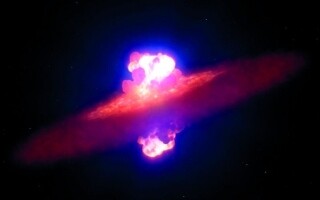
A supernova explosion is considered one of the most violent cosmic events, yet the precise shape of this phenomenon as it occurs remains mysterious. For the first time, scientists have managed to observe the very early stages of a stellar explosion when a massive star exploded in a distinctive olive-like shape. Researchers used the Very Large Telescope (VLT), part of the European Southern Observatory in Chile, to observe the stellar explosion, which involved a star with a mass about 15 times that of the Sun, located in a galaxy 22 million light-years away in the constellation Dorado. The researchers observed that the dying star was surrounded at its equator by a pre-existing disk of gas and dust. With the explosion, the matter ejected from the star's core pushed outward, deforming the star's shape into a standing olive. Study co-author Dieterich Baade stated that the star's diameter during the explosion exceeded 600 times the Sun's diameter, and the star ejected some of its mass into space. It is believed that what remains of it has turned into a neutron star, a very dense stellar remnant. Baade said: 'Once the shock breaks through the surface, huge amounts of energy are released, then the supernova flares up brightly and becomes observable for a short period. This allows us to study the initial shape of the explosion before it interacts with the matter surrounding the star.'