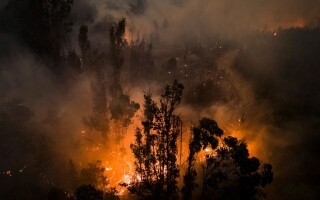
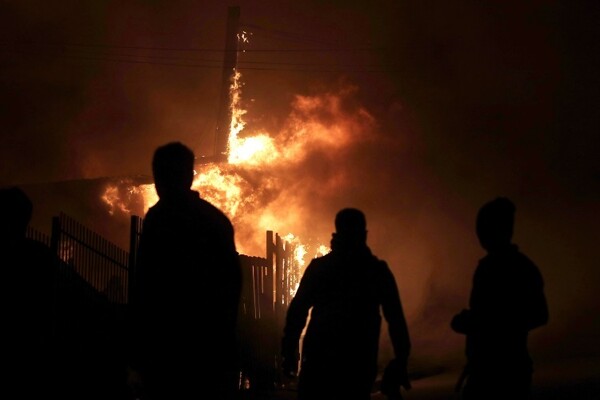
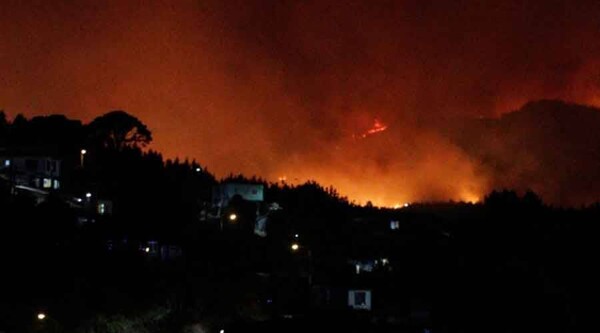
In recent years, common fires in Chile have turned into megafires ravaging forests and cities. The National Forest Corporation (Conaf) of Chile, the international scientific community, and the Ministry of the Environment explain the combined reasons for this phenomenon.
Increase in Fuel The megadrought affecting Chile has significantly reduced the relative humidity in forest soils. Additionally, since the 1970s, the country has undergone a transformation in the types of plantations for productive reasons, with more pine and eucalyptus trees. The National Forest Corporation also insists on not "demonizing" the land modification process, as "forest plantations had and have a productive purpose, with benefits." They explain that the problem is not the type of vegetation but "the continuity and fuel load at a landscape scale."
"The landscape homogenization that has occurred in Chile since the 1970s to the present day allows the fire to spread very quickly through the vegetation. The fires we have experienced are an ecological tragedy, with 800,000 hectares of natural vegetation and unique forests of endemic Chilean species that grow only here having burned," explained an expert.
Fire and Atmosphere The head of the Wildfire Development and Research Department of Chile, Jorge Saavedra, pointed out that one of the central elements of these extreme fires is the direct interaction between fire and the atmosphere.
"The fire stops being just a phenomenon that responds to the wind and begins to modify the atmospheric conditions around it, generating very intense convective columns, local wind changes, air intake towards the fire, and collapses that produce secondary foci at great distances," he explained.
Climate Change Plans The Regional Secretariat of the Ministry of the Environment of the Biobío region in Chile, where the 'Trinitarias' fire left 21 fatalities, confirmed that the new Regional Climate Change Plan focuses on mitigation and landscape management to reduce this fuel.
"The focus today cannot be only on firefighting or attributing responsibility to a specific type of forest. Landscape restoration and prevention are the main concepts," said an ecologist from the University of Chile.
In the current 2025-2026 season, which began last September, more than 64,000 hectares have been destroyed, an increase of over 226% compared to the 2024-2025 season, when 19,252 hectares burned.