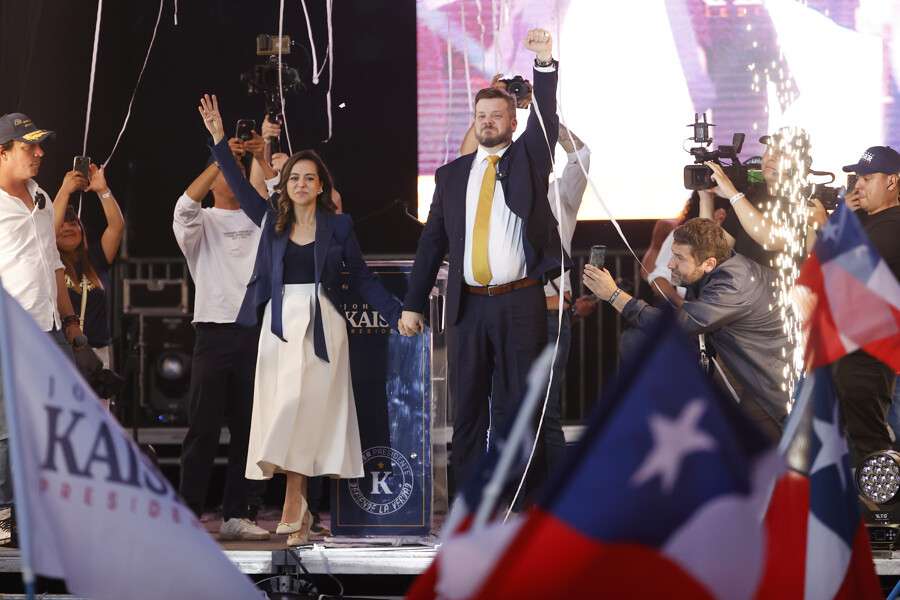
The presidential election campaign in Chile closes this Thursday after a week of massive rallies by the main candidates. The leftist Jeannette Jara and the far-right Jose Antonio Kast are favorites in most polls, though not far behind another far-right candidate, Johannes Kaiser, leader of a much more radical faction. Former minister Jara, heading the broadest coalition of progressive forces in Chilean history, and Kast, a classic Chilean far-right leader, held their campaign closing events on Tuesday with massive rallies, while Johannes Kaiser, leading a newer, more confrontational, and libertarian far-right, did so on Wednesday. This Thursday, it will be the turn of the traditional right's representative, Evelyn Matthei. According to the latest polls, published 15 days ago before the election ban, the main race is between Jara and Kast, but in recent weeks Kaiser has gained strength among voters, and some polls give him a chance to reach the December 14 runoff. This is the first time since Chile's return to democracy that there are two competitive far-right candidates with a chance to make it to the second round. With less chance is former mayor Matthei, who in her second attempt to reach La Moneda has been lagging for months. The increase in insecurity and the slowdown in economic growth have been the big themes of the campaign and the main concerns of a society with great disenchantment with politics and some electoral fatigue, as there have been more than a dozen elections since the pandemic. Jara, the first communist in Chilean history to represent the entire center-left and left, dedicated her campaign to proposing solutions to lower the 'cost of living.' Meanwhile, Kast, seeking the presidency for the third time, focused on the security crisis and migration, linking the two phenomena, and harshly criticized the current government's management. Throughout the campaign, Kast avoided moral debates and the issue of Augusto Pinochet's dictatorship (1973-1990), topics that thwarted his second attempt four years ago in the election against current President Gabriel Boric. With a rougher and more vociferous discourse, Kaiser promised a 'strong hand' on security and migration and bet on a 'free economy,' while Matthei focused her message on 'her experience and capacity to govern,' as the heir to former President Sebastian Piñera (2010-2014 and 2018-2022). Despite what the latest polls show, the scenario is open because for the first time, voting is mandatory in presidential elections that will call more than 15.6 million Chileans to the polls, of whom 5.6 million have never voted and their political tendency is unknown. In total, eight candidates aspire to succeed Boric, who cannot run for re-election and will leave La Moneda in March 2026. In addition to Jara, Kast, Kaiser, and Matthei, others are also competing but with almost no chance: economist Franco Parisi (right-wing populism), former deputy Marco Enríquez-Ominami (left), former football leader Harold Mayne-Nicholls (liberal), and professor Eduardo Artés (far-left). Along with the presidential elections, November 16 will also see parliamentary elections to elect the entire Congress (155 deputies) and 23 of the 50 senators. Photo EFE