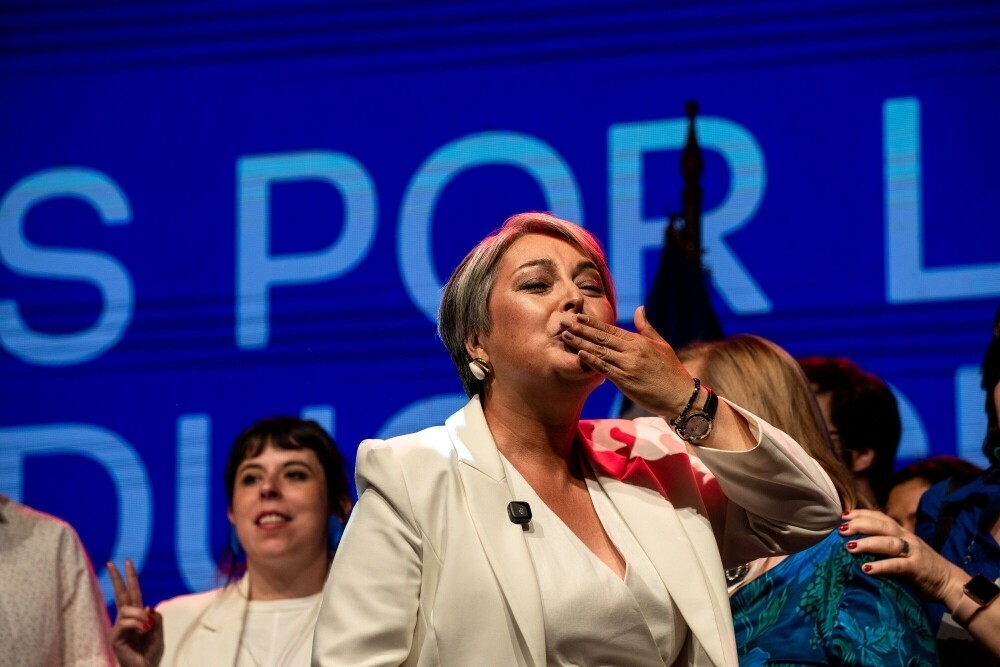
The candidate from the ruling center-left coalition, moderate communist Jeannette Jara, and the leader of the Republican Party, José Antonio Kast, have advanced to the second round of Chile's presidential elections, held this Sunday. Neither of them reached the 50% threshold required to win in the first round. With 82.97% of the vote counted, Jara leads with over 26% of the vote, followed by the Republican party candidate (24.09%). The second round of elections is scheduled for December 14. Although the total number of votes from citizens abroad is limited, they often show a trend of support for progressive forces, and this election confirmed it again. Jeannette Jara held a significant lead in main overseas voting centers, while the far-right performed poorly even in Argentina. According to preliminary figures published by the Electoral Service and Civil Registry (Servel), Jara surpassed 53% of the votes in countries across all five continents where voting took place. In Buenos Aires, Mendoza, Neuquén, and Comodoro Rivadavia, the main voting centers, turnout was similar to that of 2021. The results from abroad arrived before polls closed in Chile and allowed for the observation of a known pattern: while Jara clearly dominates among residents abroad, Kast and Kaiser show more modest results outside the country. The candidate for 'Chile Goes,' Evelyn Matthei, came in second with just over 15% of the vote, while José Antonio Kast, who will face the former minister of Gabriel Boric in a runoff, hovered around 14%. The far-right Johannes Kaiser, who appeared better positioned in polls, reached around 10%. One of the largest concentrations of registered voters abroad is in Argentina, where over 80,000 eligible Chileans reside. Exceptions were some countries in Southeast Asia like Malaysia and the Philippines, where the far-right managed to win, albeit with minimal voter rolls. As has been the case since the reinstatement of overseas voting in 2017, these votes do not decide the presidential race on their own, but they provide a clear picture of the territorial and political support for each force. The trend in our country was more marked than in other regional countries like Brazil or Uruguay: Jara reached 49% of the vote, followed by Kast at around 19%, and Kaiser at around 15%. The result of the December 14 runoff will be decisive: a victory for Jara would mean the continuation of the progressive bloc, while a triumph for Kast would mark a shift to the right with a focus on security, stricter migration, and a conservative agenda. The election will define two clearly opposing projects for the country. Johannes Kaiser: 'The trend is not reversible, and we recognize the victory of José Antonio Kast.' The candidate for the Libertarian National Party congratulated Kast on his advancement to the runoff and announced that his movement will support his candidacy, stating that 'the alternative is Mrs. Jara.' 'We are a force that has come to stay in national politics, and we will ensure that the healthy doctrine of defending the principles of freedom is not abandoned in a future government,' expressed the leader, considered by many to be the Chilean version of Javier Milei. Franco Parisi told Jara and Kast to 'earn the votes.' The candidate for the 'Party of the People,' who came in third in this Sunday's election, emphasized that his movement was 'a hair's breadth from passing to the second round.' Although he stated he is willing to 'help the next president of Chile,' he warned that he does not intend to 'sign a blank check for anyone.' We believe in the middle class, in meritocracy, we do not like ideologies. The former Minister of Labor came in first but without enough votes to succeed Gabriel Boric. Facing the December 14 runoff, Kast is better positioned thanks to the support of other right-wing candidates, such as Johannes Kaiser and Evelyn Matthei, which could consolidate a conservative front.