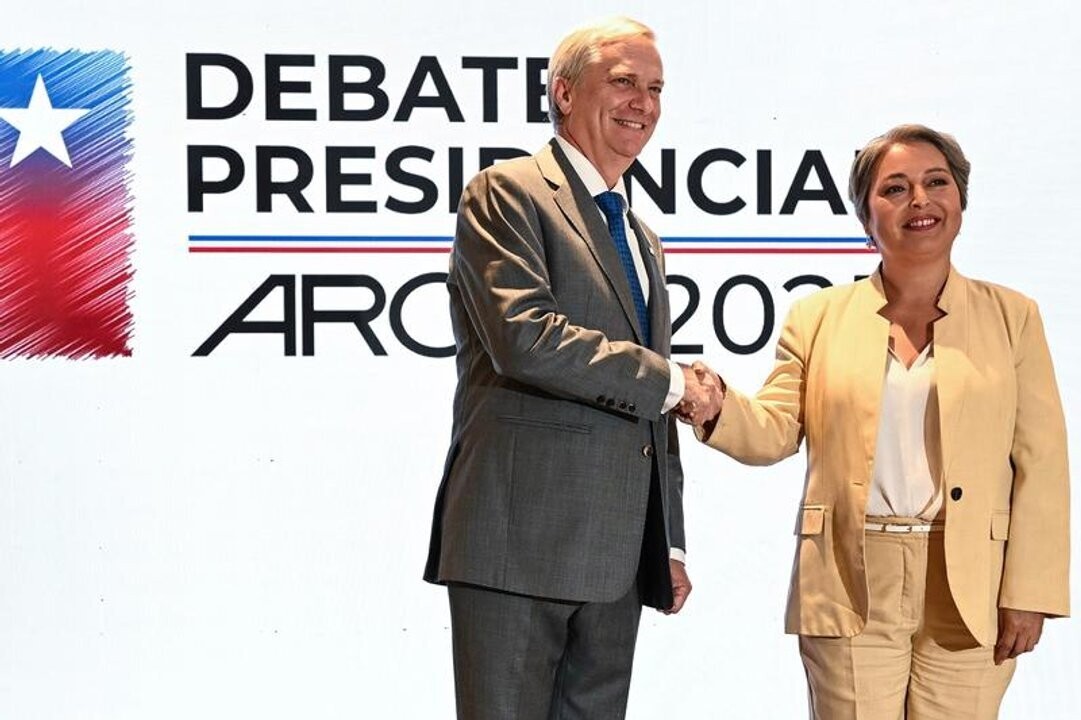
Tomorrow, Chile will elect a new president in a runoff election that will pit the leftist Jeannette Jara against the far-right founder of the Republican Party, José Antonio Kast. Jara, a member of the Communist Party and backed by the ruling administration, will face the opposition Kast, who, according to data collected by Agencia Noticias Argentinas, is considered the son of a member of the Nazi Party in Germany. Both candidates, competing for the 2026-2030 term, are not part of the traditional centrist political parties that have governed the South American nation over the last two decades, an analysis by the Xinhua news agency notes. According to opinion polls, Kast, who is running for president for the third time, will take the top executive post in the South American country. Nearly 16 million people were eligible to participate in Chile's first mandatory presidential election, which will determine the new head of state. Jara narrowly won the first round on November 16 with 26.8% of the vote, and Kast, with 23.9% of the preferences, advanced to the presidential runoff to be held this Sunday. Kast closed his campaign in the city of Temuco, located about 670 kilometers south of Santiago and the capital of the Araucanía region, at an event where he spoke again protected by a bulletproof glass. The republican had launched his campaign in the very same city, turning the locality into one of his strongholds, in line with his tough stance on the Mapuche conflict in the region. During his speech, the Republican candidate focused his criticism on the government of Gabriel Boric: 'The most incredible thing is that this government had everything it needed to do things right; it lacked nothing, it didn't have a pandemic, it didn't have an explosion, it promised to solve everything.' Jara, for her part, held her last event in the city of Coquimbo, in Chile's so-called Little North. After reviewing some of her achievements as Minister of Labor under Boric—such as the increase in the minimum wage or the reduction of the working day—the candidate promised 'concrete measures' to combat insecurity and guarantee economic improvements so that Chileans can 'make ends meet.' The events in Temuco and Coquimbo closed a week that had begun with the debate organized by the National Association of Television of Chile (Anatel), the last face-to-face between the contenders for La Moneda before the elections. As on some previous occasions, the crossfire between the candidates was marked by Jara's insistence that Kast explain some of his most controversial measures, such as the expulsion of 300,000 irregular migrants or an adjustment of 6 billion dollars. The path to the second round was marked by the prominence of Franco Parisi, a candidate for the People's Party who, surprisingly, placed third in the preferences during the first round with 19.71% of the vote. This result allowed the candidate and his more than 2.5 million voters to be at the center of the political debate. Unlike the immediate support received by candidates Johannes Kaiser (Libertarian National Party) and Evelyn Matthei (Chile Grande y Unido), Parisi avoided automatic alignment with Kast and identified his party as 'neither fascist nor commie.' Furthermore, he called on his voters to decide, through an online consultation, what position to adopt, achieving that 78% of participants leaned towards a blank or null vote. Chilean political scientist Rodrigo Karmy (consulted by Sputnik News) opined that, far from lending his votes to Jara or Kast, Parisi managed to position himself as a sort of 'third participant in the runoff.' Two other candidates, Johannes Kaiser and Matthei, secured their support for Kast from the day of the first round, but the undecided, those who did not vote in the first round, and Parisi's volatile electorate will be the ones to tip the balance, according to a recent opinion by the UBA professor in Argentina, José Antonio Cárcamo, of Chilean origin. The vote of Chileans in Argentina The Chilean community residing in the Autonomous City of Buenos Aires will be able to vote next Sunday to choose their next president at a school in Retiro. For these elections in the neighboring country, the Buenos Aires City Government will set up a special operation in Buenos Aires involving the ministries of Justice, Security, and Education, and will also provide infrastructure. So tomorrow, the City will open Primary School No. 6 at Basavilbaso 1295, corner Juncal, in Retiro, so that Chilean citizens can vote between 8 and 12, with a dozen polling stations.