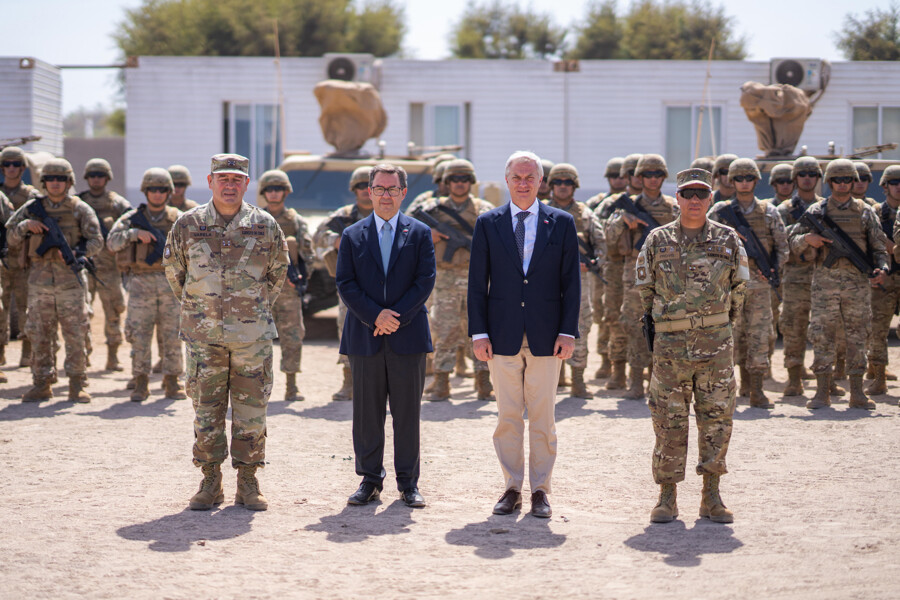
The President of Chile, José Antonio Kast, presented this Monday the so-called ‘Plan Escudo Fronterizo’, a strategy that contemplates ditches, walls up to five meters high and a greater military deployment to contain irregular immigration on the border with Peru and Bolivia.
Accompanied by a large official delegation, including the Minister of Public Security, Trinidad Steinert; of the Interior, Claudio Alvarado, and of National Defense, Fernando Barros, Kast will visit military bases and border complexes to coordinate the process that has already begun with the construction of barriers.
In addition to deepening the existing ditches on the border and digging new furrows, Kast's plan contemplates the construction of walls and railings up to five meters high, the placement of barbed wire and the deployment of military technology and autonomous drones to increase surveillance.
A few hours after assuming the Presidency of the South American country, the far-right Kast signed a series of decrees focused on irregular migration, documents where he ordered his ministers to 'manage legal changes to discourage irregular immigration', 'modify the rules of the use of force to generate more tools against clandestine entry' and 'the construction of physical barriers for required sectors'.
In the same vein, Kast signed a second decree titled 'National Border Closure Policy', which urges the ministries of Defense, Interior and National Assets to 'increase military means' on the northern border, 'improve surveillance through drones and optronic sensors' and the 'improvement of communications'.
Migration has doubled since 2017 and currently represents more than 8% of the population, according to the National Statistics Institute (INE), which estimates that there are more than 330,000 migrants in an irregular situation, mostly Venezuelans.
In total, about one million Venezuelan citizens live in Chile, the majority integrated into the country and with a contribution to fiscal revenues of 1.03%, equivalent to 0.15% of the national GDP, according to data from the International Organization for Migration (IOM).
According to official figures, irregular entries of people have decreased by 54% compared to the crisis that occurred four years ago.